
Storage During Water Damage Restoration
When water gets into a building, the clock starts. Wet drywall, flooring, and framing have to be dried within days or mold sets in - and the belongings in those rooms are on the same clock. Getting furniture, boxes, and equipment out of the wet zone fast is often the difference between drying them out and throwing them away, which is exactly why most insurance policies expect contents to be moved out of harm's way. That is the job water damage restoration storage does: a clean, dry place for your things to go the moment they come out, while the drying and rebuild run behind them. Box-n-Go brings the container to you, usually within 48 hours, so your belongings are out of the water the same week the loss happens.
Whether it is your own property or a job you are running as the restoration crew, those contents have to go somewhere while the drying and repairs happen - and where they go should be a decision, not the default nobody chose. Click the card that represents you to see what we can do.


Where Do Your Belongings Go During Water Damage Restoration?
When your property floods, the first move is the phone. You call a water damage restoration service to get a crew out and drying - the water damage restoration services near me, or one of the flood restoration companies near me. Maybe you reach a water mitigation company near me to stop the spread, or compare the best water restoration companies. What none of them settles is where your belongings go - and that is what this page answers.
The restoration crew needs those rooms clear to pull baseboards, lift flooring, and set up drying equipment - and your things need somewhere dry to wait while that happens. There are really only three places they can go: back on your property in a container, indoors at a secure facility, or - in the version nobody chooses on purpose - trucked to a restoration company's warehouse across town, into storage you never see.
That last one is what most people get by default. A crew packs everything, it disappears to a warehouse, and it is billed to your claim. Need one box of documents back on a Tuesday? That is a service request, a scheduling window, and sometimes a fee. Box-n-Go gives you the first two places instead, on your terms.

The do-it-yourself version - renting a truck and a self-storage unit mid-crisis - trades one problem for a weekend of heavy lifting at the worst possible time. Box-n-Go puts both places storage can happen into one arrangement: as many containers as the loss calls for, delivered to your property and kept there while you want your things close, then picked up and moved indoors to our facility, still loaded, if the site gets crowded or you relocate. On your property, at our facility, or one then the other as the job changes, everything is loaded once and nothing disappears across town.
 On-Site
 Our Facility
 Move
MoveLoad it yourself or add our crew. Stored and moved on your schedule.
On Your Driveway, Under Your Own Lock
The simplest answer for storage during water damage repair is a container in the driveway. Box-n-Go delivers across Los Angeles and Orange County, typically within 48 hours and often sooner. It sits at ground level - no ramps - so you or a crew move the salvageable contents straight in. You secure it yourself and the key never leaves your pocket. While the drying equipment runs and the repairs happen inside, everything you own is twenty feet from your door, where you can see it and reach it whenever you need to. Five sizes cover everything from a single flooded room to a whole-house pack-out.
The gallery below lays those sizes out, from a single Flex to a 20-foot container - you just order more or fewer units as the contents come out, and the storage size calculator helps you size it.
- No Truck Rental
- Stored On-Site or at Our Facility
- No Loading Ramps, Ground Level









- No Truck Rental
- Stored On-Site or at Our Facility
- No Loading Ramps, Ground Level
Box-n-Go Storage Unit Sizes for Business
Keep the Salvageable Apart from the Questionable
A water loss sorts your belongings into piles: things that are fine, things that are damp and need to dry or be cleaned, and things the adjuster still has to see before anyone decides. Modular Flex units let you keep those piles apart instead of piling everything into one box - dry, salvageable furniture in one unit, damp items that need attention in another, adjuster-review pieces in a third. You order what the job might need and pay only for the units you actually use.
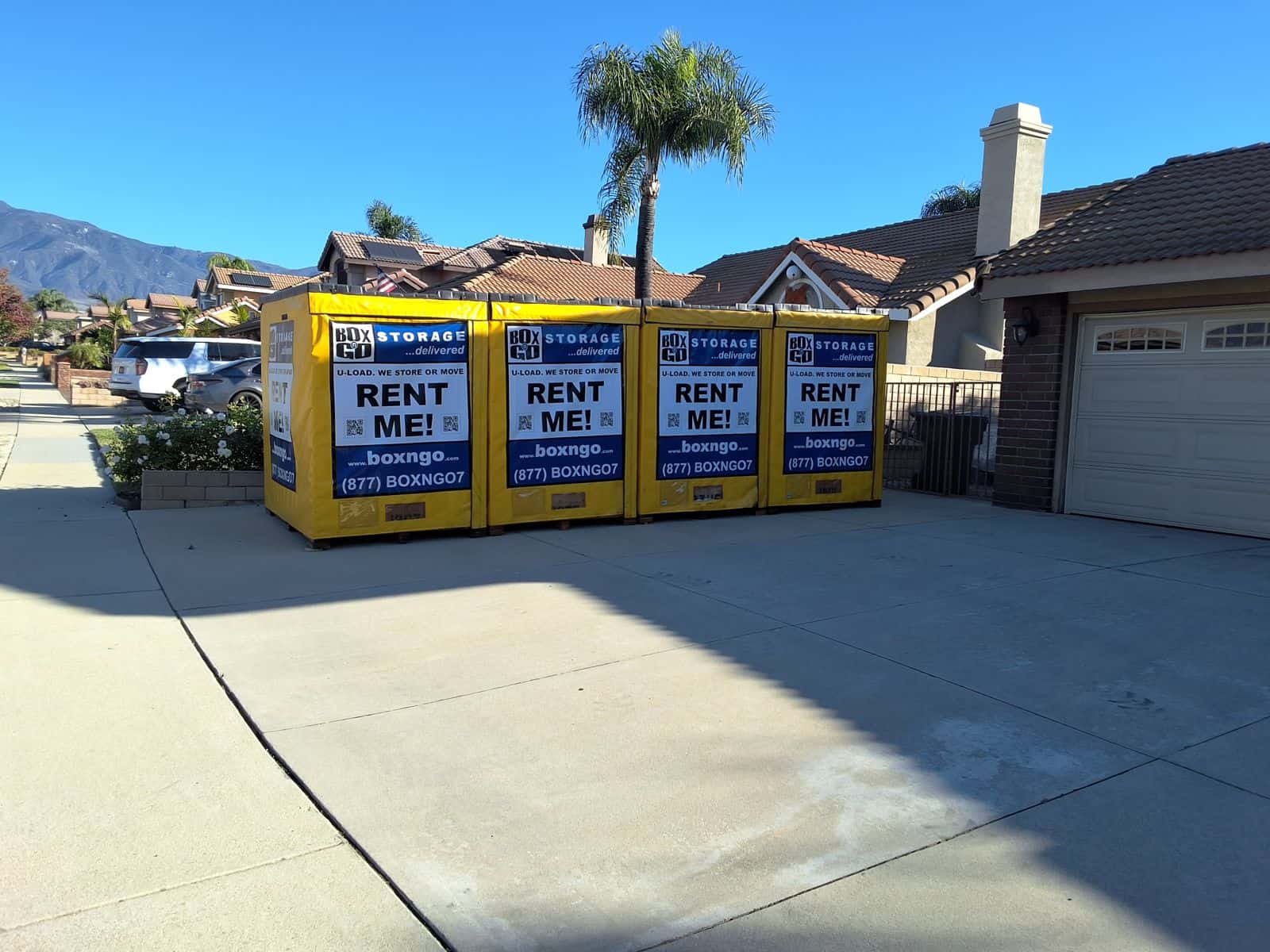
Can't Face Packing in the Middle of a Flood? A Licensed, Insured Crew Can
Right after a water loss is not when most people want to be hauling furniture, and you do not have to. Box-n-Go arranges a licensed, insured crew through our moving partner to pack the salvageable contents and load the container for you, so the wet rooms clear quickly and nothing waits around growing mold while you find the time. You handle the claim and the decisions; the heavy, time-sensitive part gets done by people who do it every day. The full move-out - packed, inventoried, and returned when the rebuild is done - lives on the full-service packing page.
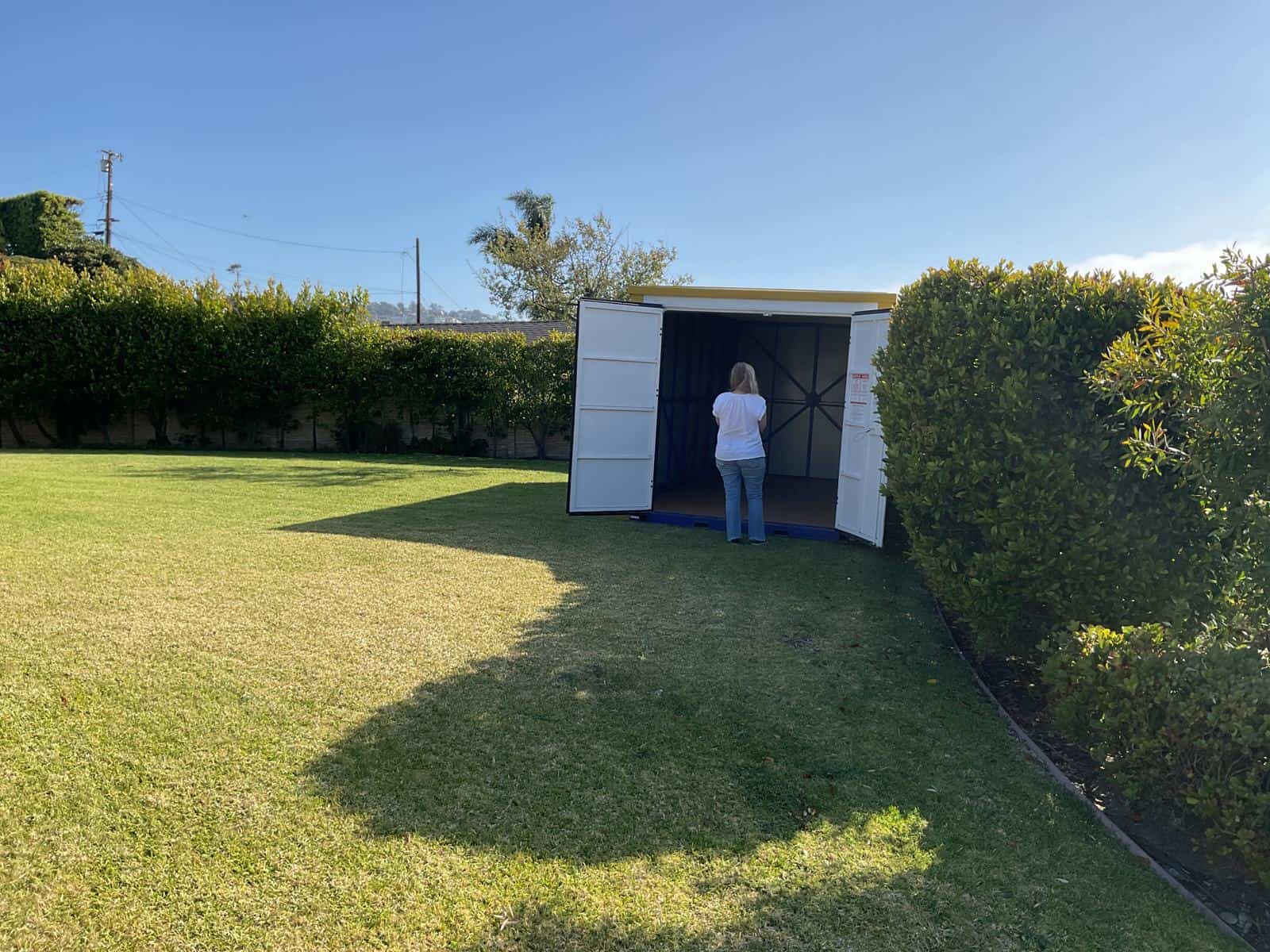
When On-Site Isn't an Option: Storage at Our Facility
Not every water loss leaves room for a container. A gut-and-dry job can claim the whole driveway for the restoration crew's equipment and dumpsters, and a serious loss can put the household into temporary housing altogether. Either way the answer is the same: we pick up the loaded container and keep it indoors at our facility - concrete construction, monitored video and alarms, no public access, and a steady climate that will not cook or dampen what the water spared - how that compares to a self-storage unit. Furniture, boxes, and casework stay dry with us until the rooms are ready for them to come home.
Storage runs month to month with no fixed term, because nobody can promise how long a rebuild takes - and if you already know yours will run long, optional term plans bring the monthly rate below month-to-month. When the property is ready, the same container comes back for unloading: one load, one unload, no matter how long the middle lasted.
The Insurance Question
Moving and storing contents is often part of a covered water-damage loss - many policies pay to relocate and store belongings while the property is restored, and some cover temporary housing under loss-of-use. Coverage varies, so ask your adjuster and never assume either way. What we can promise is paperwork that helps rather than hurts: a simple itemized invoice for delivery and monthly storage that drops cleanly into a claim file, with no bundled line items to argue over.
The first day after a water loss is a blur of decisions. We wrote them down in order.
First 24 Hours - After Disaster Strikes - a one-page checklist you can print and work through. Free download, no email required.
How Fast, and How Long? The Water-Damage Timeline
Two questions come up on every water loss: how fast can the container get here, and how long will my things be in it. On speed, a container typically reaches your property within 48 hours - fast enough to clear the wet rooms before mold gets a head start. On duration, the drying itself usually runs three to five days, longer for a bigger intrusion or contaminated water; then the repairs - flooring, drywall, paint - can add a week or two, sometimes three on a larger loss. Because your storage is month-to-month, you are not guessing that timeline up front or paying for time you do not use.
- Call or order online in minutes
- We deliver to your site
- Load on your schedule, or add our crew
- Store on-site or at our secure facility
- Pay only for the space you use
Video transcript
Box-n-Go Storage, Introducing 16′ and 20′ Containers. About one minute, set to upbeat instrumental music with no spoken narration. The information is shown as on-screen titles over footage:
- Opening title over a spinning globe: "Box N Go Storage."
- "Box N Go Storage, Introducing 16′ and 20′ Containers."
- "Delivery Vehicle and Placement", a white Box-n-Go portable container is delivered and set down on a residential driveway (palm trees, a car in the drive) by a compact delivery truck with a lift. The container is branded "Rent Me! www.boxngo.com · (877) 269-6461."
- "Our Team Onsite Gets Super", the Box-n-Go team on site, delivering and positioning a container at a facility and a driveway.
- Playful cast-style titles: "Box N Go Team, aka Fantastic," "Stan, aka Inverto Men," "Team, aka The Professionals."
- Closing title: "Box N Go Storage, L-XL Containers," followed by mock movie-style end credits.
Summary: Box-n-Go now offers its largest portable storage containers, 16′ and 20′ (L and XL), delivered and placed at your location in Southern California, ideal for business and commercial storage that needs more room in a single unit.
For Restoration Contractors: The Contents Side, Handled
Everything above is written for the person whose property flooded. But there is another side to every water loss - the contractor running the repair - and the contents are their problem too. The structure cannot dry and demo cannot start while the rooms are full. Box-n-Go is the container that lives on the customer's property so your crew can work, delivered where you point, on your job's schedule.
Small Mitigation Firms: Offer Pack-Out Without Building a Contents Division
You cut the flooded drywall and set the drying equipment; contents were never your trade. That means walking away from jobs where the customer needs the whole house handled - and watching the full-service companies take them. One call changes what you can bid: Box-n-Go delivers the container to the loss, your crew or ours loads the contents, and it stores on-site or at our indoor facility until put-back. Quote the whole job, contents included, with no warehouse, box trucks, or contents team to staff and insure - the full business case for Box-n-Go lays out why contractors make us a standing partner.

Seasonal & overflow inventory.
Furniture, fixtures & displays.
Secured finish materials.
- Outside
- 20′ L × 8′ W × 7.5′ H
- Inside
- 231″ L × 90″ W × 83.5″ H
- Door Opening
- 68″ W × 74″ H
- Capacity
- 1000 Cu. Ft. or 10,000 LBS
- Clear Req'd
- 23′ L × 8.5′ W × 8′ H

Office & retail relocations.
Store back-stock & supplies.
Furniture between locations.
- Outside
- 16′ L × 8′ W × 7.5′ H
- Inside
- 189″ L × 90″ W × 83.5″ H
- Door Opening
- 68″ W × 74″ H
- Capacity
- 821 Cu. Ft. or 7,300 LBS
- Clear Req'd
- 19′ L × 8.5′ W × 8′ H

Scaling up or down.
Unsure how much you need.
Pay only for the space you use.
- Outside
- 8′ L × 5′ W × 7.3′ H
- Inside
- 93″ L × 57″ W × 78″ H
- Door Opening
- 47″ W × 78″ H
- Capacity
- 240 Cu.Ft or 2,000 LBS
- Clear Req'd
- 8.5′ L × 8.5′ W × 8.5′ H
Full-Service Firms: The Option Your Warehouse Model Doesn't Have
You own vaults, trucks, and a contents team. What you do not have is a container that lives on the customer's driveway. When an adjuster wants contents kept on-site, when a customer will not let their things leave the property, or when a competitor bids "your belongings never leave your home," we are that capability, subcontracted under your job: 16- and 20-foot containers delivered where you point. We are also overflow - when a storm event fills your warehouse, containers and indoor storage scale with the event instead of trucking back to a building that is already full.
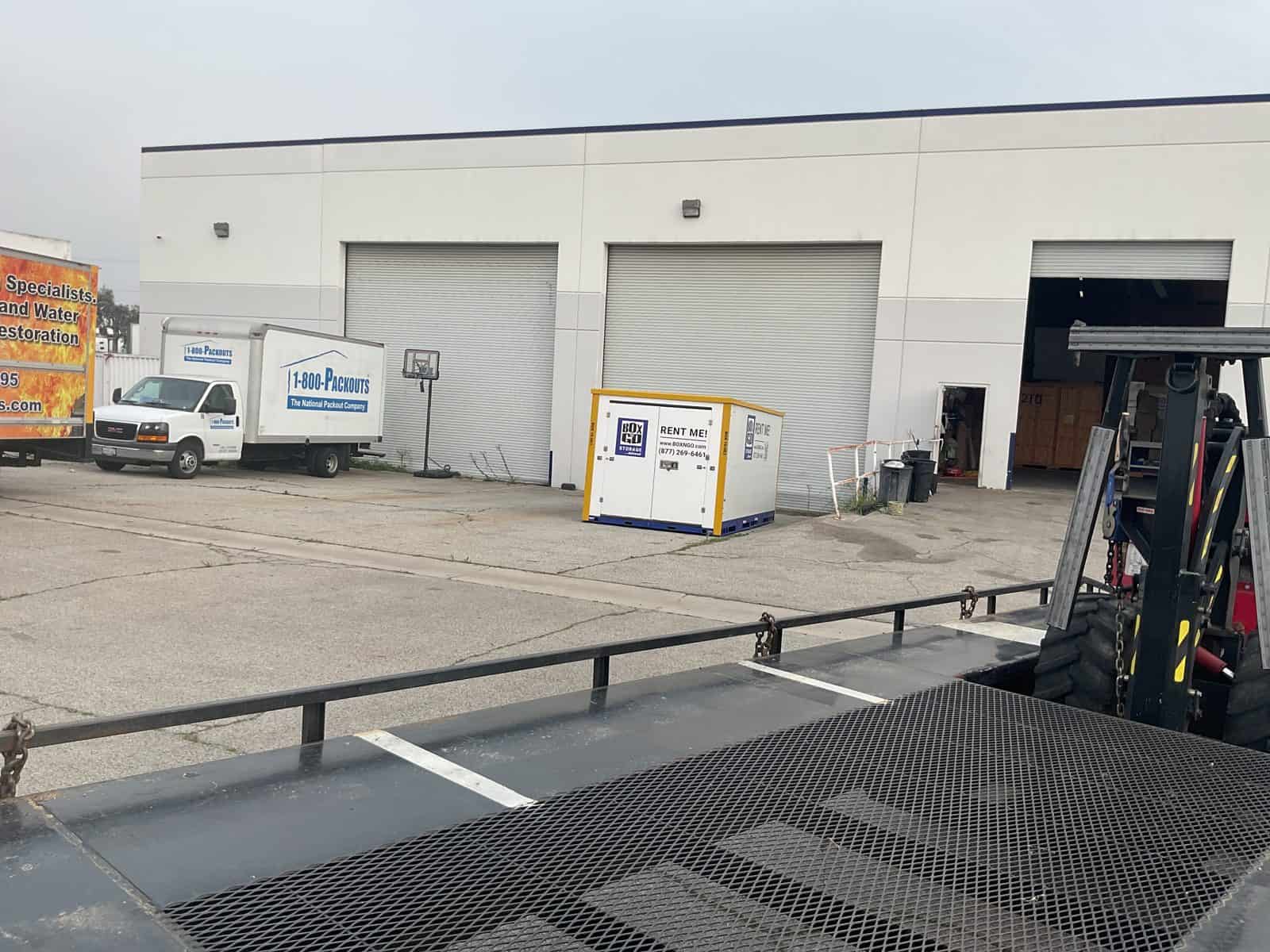
For Insurance Professionals
Adjusters and agents call us for the same two reasons. Adjusters get a clean file: one itemized invoice for delivery and monthly storage, no bundled warehouse fees to dispute, and contents that stayed on the property with the policyholder. Agents get to be the person with the answer in a client's worst week - when the "where do my things go" question comes, the agent who can say "a container on your driveway within 48 hours" earns loyalty that outlasts the claim. Our First 24 Hours checklist is available co-branded for agencies; ask us.
How Water Damage Restoration Storage Works
The process is the same simple loop whether you are a homeowner mid-loss or a contractor running the job: we deliver a container to the property, you or a crew load the salvageable contents, and it stays on-site or comes to our facility while the rooms are dried and repaired. When the work is done, the container comes back and you unload into finished space - one company from the driveway to the rebuild, no separate pack-out vendor and no double-handling - see exactly how Box-n-Go works.
Storage
Storage
Moving

Help

Relocations
Storage is where a water loss touches us first, but rarely where it ends. A displaced household needs a move to temporary housing and another one back; a flooded business searching for commercial water damage restoration services turns into an office relocation; a household that cannot lift needs a loading crew. All of it is one arrangement away from the same local team that brought the container - the same operation doing this since 2006, with zero break-ins at the facility in that entire run. Water is one of several perils the same container clears - it handles a fire or smoke loss or a mold remediation the same way - and it is one piece of Box-n-Go business storage; the full restoration picture lives on the restoration storage overview.
Water losses do not leave time to gamble on a storage company, and customers say so afterward - the reviews below mention fast delivery, careful placement into tight spots, and clean containers that showed up when the rest of the week had gone wrong.
★★★★★
"Smooth & efficient self storage process. Pod was placed in my driveway in no time. If you need a storage pod delivered, ask for Salvador."
- Daniel V.
★★★★★
"We used Box n Go for moving several times and had nothing but good experiences. The storage containers were always clean and well maintained, easy to pack at the ground level. Their storage and moving system totally worked for us."
- Kimberly L.
★★★★★
"Salvador was my storage pod delivery driver. He is a master at maneuvering those storage units. They are so large, but he drives them around with ease."
- Bette M.
★★★★★
"We have used Box-n-Go twice and in both cases found them to be competitive and easy to work with. Freddy is always helpful and their storage prices are reasonable."
- Cynthia G.
Water Damage Storage Questions, Answered
Where do my belongings go during water damage restoration?
Into a Box-n-Go container - kept on your driveway and secured by you, or picked up and stored indoors at our facility if the site is too crowded or you have to relocate. Either way your things come out of the wet rooms fast and stay dry until the repairs are done.
How fast can a container arrive after water damage?
Usually within 48 hours. Getting contents out of the wet zone quickly is what saves them, so the container is built to arrive before mold has a chance to spread.
How long does water damage dry-out and restoration take?
Drying typically runs three to five days, longer for a large or contaminated loss; repairs can add another one to three weeks. Your storage is month-to-month, so the container stays as long as the rebuild takes and no longer.
Should my belongings stay at my property or move to an off-site facility?
Either can be right, and you do not have to choose once. The same container sits at your property while you want your things close, moves to our indoor climate-friendly facility if the site gets crowded or you relocate, and comes back for unloading when the rebuild is done. Ask your adjuster what your contents coverage includes either way.
Does insurance cover storage during water damage restoration?
Often, yes - many property policies cover moving and storing contents as part of a covered water loss, and some cover temporary housing under loss-of-use. Coverage differs by policy, so ask your adjuster before assuming. Box-n-Go provides a simple itemized invoice that files cleanly with a claim.
Can my water-damaged furniture be saved?
Speed decides it. Solid-wood pieces that are dried and cleaned quickly often recover; soaked upholstery, mattresses, and particleboard usually do not, because moisture and mold work fast. Getting salvageable items out and into a dry container early is what keeps the 'save' pile larger than the 'toss' pile.
Have a question these did not cover? Every answer from across our business storage pages lives in one place - the Business Storage FAQ.
Restoration Terms, in Plain English
The restoration industry has its own vocabulary, and it lands on you mid-crisis. Here is what the words on your estimate and claim actually mean.
Water mitigation
The emergency first phase - stopping the source, extracting standing water, and starting the drying - done before any rebuilding, to limit how far the damage spreads.
Water extraction
Pumping and vacuuming standing water out of the building; the first hands-on step, done before the drying equipment goes in.
Standing water
Water that has pooled and stopped moving. The longer it sits, the deeper it soaks into floors, walls, and contents, which is why removing it is the first priority.
Category 1 / 2 / 3 water
How clean the water is: Category 1 is clean supply-line water, Category 2 is 'gray' water with some contamination, Category 3 is 'black' water (sewage or flood) that requires the most caution with contents.
Class of water loss (1 to 4)
A separate rating from Category, measuring how much material got wet and how hard it is to dry - from a small surface spill (Class 1) up to water wicked deep into walls and slow-drying cavities (Class 4).
Wicking
The way water climbs upward through porous materials like drywall and framing, leaving them wet well above the visible water line.
Secondary damage
Damage that shows up later from moisture left too long - warping, swelling, staining, and mold - as opposed to the initial water event itself.
Structural drying (dry-out)
Drying the building itself - framing, subfloor, drywall - with air movers and dehumidifiers, measured with moisture readings until it is dry enough to repair.
Air movers and dehumidifiers
The drying equipment: high-velocity fans push air across wet surfaces to speed evaporation while dehumidifiers pull that moisture out of the air.
Moisture content
How much water is held in a material, read with a meter. The crew tracks it down over the days of drying until it matches a dry, unaffected area.
Moisture mapping
Using moisture meters and infrared cameras to trace how far the water traveled - including behind walls and under floors - and to plan the drying.
Thermal imaging
An infrared camera scan that reveals cool, damp areas hidden inside walls and ceilings that a surface look would miss.
Dry standard
The target moisture level - taken from an unaffected part of the building - that wet materials must reach before repairs begin; how the crew knows the dry-out is genuinely finished.
Flood cut
Removing drywall to a set height above the water line, often 12 to 24 inches, so wet material and hidden moisture come out and the wall cavity can dry.
Controlled demolition
Selective removal of unsalvageable wet materials - drywall, insulation, flooring - done deliberately to open the structure for drying, not a teardown.
Antimicrobial treatment
A biocide applied to wet materials to slow or stop mold and bacteria while the structure dries.
Containment
Sealing off the work area with plastic sheeting and controlled airflow so moisture, dust, and mold spores do not spread into clean parts of the building.
Air scrubber (HEPA / negative air)
A filtered machine that pulls airborne particles and mold spores out of the work area and holds it under negative pressure so contaminated air does not drift into clean rooms.
Mold remediation
Removing mold growth and the moisture feeding it, then cleaning and clearing the area - needed when water sat long enough for mold to start.
Deodorization
Removing the musty or contaminated odors a water loss leaves behind, rather than masking them, once the source and the moisture are gone.
Contents pack-out
Removing your belongings from the damaged area so the work can happen and the contents can be dried, cleaned, and kept safe - then returned when the space is ready.
Contents manipulation
The insurance term for moving your belongings so the work can happen - shifting, covering, or relocating them room to room or off the property.
Contents cleaning
Cleaning, drying, and deodorizing the salvageable belongings the water touched, so they can go back once the rooms are ready.
Salvageable contents
The belongings the water spared, or that can be dried and cleaned - the things worth protecting in storage while the work runs.
Total loss inventory
An itemized list of belongings too damaged to save, with photos and values, used to settle the contents portion of an insurance claim.
Put-back
The final step of a restoration project: returning stored belongings to their rooms once the rebuild is finished.
Remediation
Removing and correcting the damage and its causes - wet materials, contamination, and mold - so the space is safe to rebuild.
Scope of loss
The written description of everything the loss damaged and the work required to fix it, agreed between the contractor and the adjuster before repairs begin.
Loss of use (additional living expenses)
The part of a homeowners policy that can pay for temporary housing and related costs while your home is uninhabitable during restoration.
Actual cash value vs. replacement cost
Two ways a claim pays: actual cash value is the depreciated worth of an item, replacement cost is what a new equivalent costs today; many policies pay the difference once you actually replace the item.
Learn More About Restoration Storage
- Restoration storage overview - the vetted local contractor directory and how the container fits fire, smoke, and mold losses too
- Full-service packing and loading - a licensed, insured crew packs the whole home
- First 24 Hours checklist (PDF) - the first day after a loss, written down in order
- On-site storage containers - how a container works when it stays at the property
- Business storage - on-site and facility storage across the range of what we do
Get Started
Water losses do not wait, which is why restoration crews run 24/7 water damage restoration services - and our dispatch keeps the same hours. Call 877-269-6461 - in an active loss, say so, and dispatch will treat it that way - or find us on Google, or contact our team. For a multi-container loss, a long rebuild, or recurring restoration work, ask for a custom quote below.
GET A CUSTOM QUOTE
Service Area
Box-n-Go delivers water damage restoration storage across Los Angeles County and Orange County, with delivery into parts of Ventura, San Bernardino, and Riverside counties - the same coverage the local restoration industry works.
