
Getting Started: How to Prep for Your Moving or Storage
The decisions you make before you tape up the first box make the biggest difference in how the rest of your move or storage goes. This page walks through everything that happens before packing starts: planning, sorting, supplies, what to do with appliances, and a few things that simply can't be packed into a storage container. Spend a couple of hours on the prep below and you'll save yourself days of trouble later - whether you're moving across town, shipping cross-country, or sending things to our warehouse for a while. When you're ready to actually start packing and protecting your belongings, see our packing and protecting guide. For what happens after that, we have separate guides for loading your storage container and unloading at your destination.
Make a list and sort first
Before you put anything in a box, walk through your home one room at a time and write down what's there. A notebook page per room works. So does a photo of every shelf and closet on your phone. The point is to see what you actually own all in one go, instead of finding it three weeks later under a bed.
Then sort everything into five piles:
- Keep and pack - anything going with you or to storage.
- Donate - gently used items someone else can use.
- Sell - things with resale value that won't fit your new place or your storage budget.
- Toss - broken or worn out.
- Take with you personally - valuables and important papers (more on these below).
Be honest with yourself in the donate, sell, and toss piles. Every item you pack costs money - by weight if you're moving long distance, by how much room it takes if you're using full-service movers, and by storage container space if you're self-loading or storing. A weekend of sorting saves more than it costs. And the new home (or the unpacking day later) is much calmer when you're only opening boxes of things you actually want.
Take photos of anything valuable before it's packed in a box - electronics, jewelry, artwork, antiques, anything you'd want to prove existed if something went wrong. Photos take seconds and answer questions you can't predict.
 We Deliver
 We Pick Up
 We Store/Move
Store on your driveway or inside our secure facility. Load/unload only once. Ground level access.
How many storage containers will you need?
The number of storage containers you need depends on how much stuff you have to move or store - not the square footage of your home, exactly, but the volume of furniture and belongings you actually need to move or store. Estimating this before you start packing avoids two opposite problems: paying for space you never fill, or running out of room halfway through with no way to finish.
Two tools can help you estimate. Our storage size estimator gives you a storage container count based on home size and how full it feels. Our moving budget estimator goes a step further for moves - it gives you a budget range for self-move or full-service moves, local or long-distance.
Box-n-Go offers five storage container sizes, and they break into two different ways of thinking about your space. Four of them - Small, Medium, Large, and Extra-Large - are standard-size choices: you pick the one that matches your load and commit to that size. The fifth - our 8 feet by 5 feet unit, which we call Flex - is the modular alternative to picking a single standard size. With Flex, you order as many storage containers as you think you'll need, load what fits, and pay only for the ones you actually use. Anything you'd do with a standard-size Small, Medium, Large, or Extra-Large you can do with Flex storage containers instead - often better - because you're never committed to one size up front. For the full lineup with dimensions and weight limits, see our storage container sizes and weight limits page.
When Flex is the smart choice. Three situations where customers reach for Flex:
- You're not sure how much space you'll need. Two Flex storage containers hold roughly what fits in a Small. Three Flex roughly approach a Medium. Four Flex are close to a Large. Order your best guess plus one or two extra. If you don't load them, they come back empty and you don't pay for them.
- Your load turns out different than planned. Mid-pack, you realize there's more (or less) than you thought. With Flex, you don't have to scramble to upgrade or end up paying for empty space - you fill what fits and we only charge for those.
- The standard sizes are unavailable. We hold the largest inventory of Flex storage containers in our fleet. The standard sizes (Small, Medium, Large, Extra-Large) are more limited and can run out during high-demand periods. Flex is the size we always have on hand.
For an overview of how the service works end-to-end, see storage services if you're storing or moving services if you're moving. Students have their own service path - see student storage and moving. Businesses use business storage.
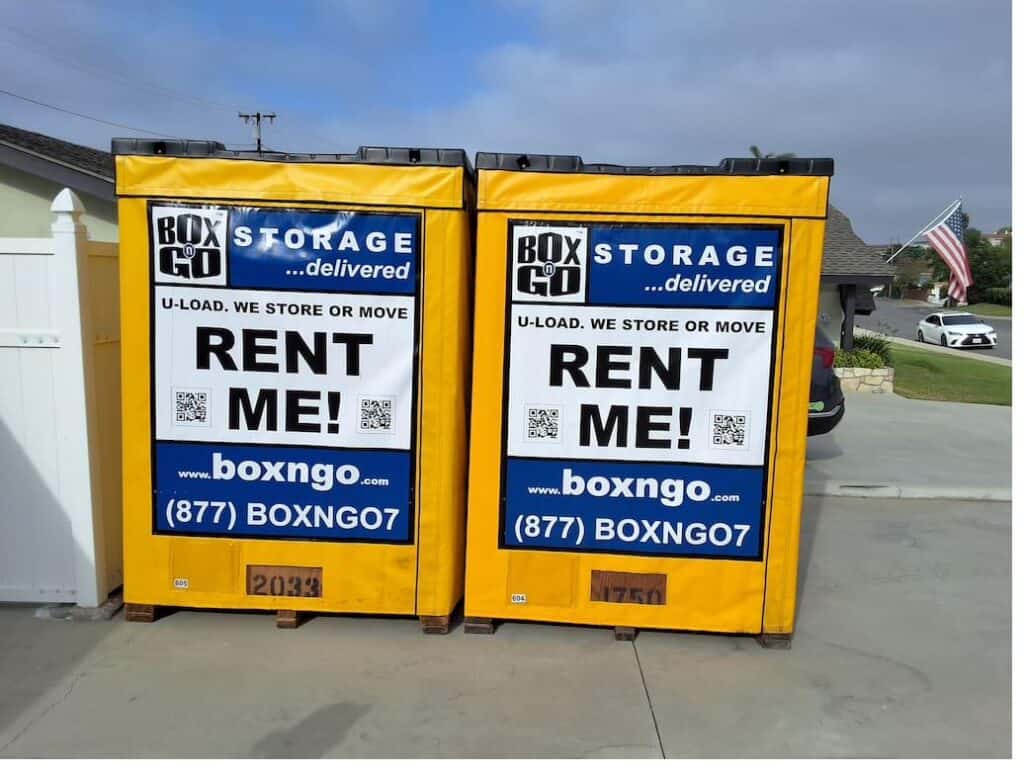
Plan where the storage container will sit
Picking the spot is part of getting ready - and an easier decision than most customers expect. Our delivery vehicles only need about 8 and a half feet of width and 8 and a half feet of height to drop a storage container at your spot - narrow enough to reach driveways, side yards, hillside properties, and tight access points that a traditional moving truck would never fit. Most homes have at least one spot that works; many have several.
Pick the spot ahead of time. A few things to check before delivery day:
- Is there enough clearance? We need roughly 8 and a half feet wide by 8 and a half feet tall of clear space to drop a storage container (and a bit more for the larger sizes). Driveways, paved areas, or firm level lawn all work. Watch for low-hanging tree branches and overhead wires.
- Will your HOA or city care? Some homeowners' associations have rules about how long a storage container can sit outside, and a few cities require a permit. A quick call to your HOA office or city before delivery saves you an awkward letter later. If you're not sure, ask us - we deliver in Southern California every day and can usually tell you what's typical for your area.
- How close to the door? The closer the storage container is to where your stuff lives, the less carrying you do. We try to place it right where you want it; just have the spot picked.
- How long can it sit? If you're packing at home and we're picking up to take to our warehouse, our standard is up to five days at your place. If you need more time, call us at least one business day before pickup and we'll reschedule. If the storage container stays at your home (rather than coming back to our warehouse), there's no rush.
After delivery, if your storage container goes to our warehouse and you later need something out of it, you can either schedule a visit to access the storage container at our facility or have us redeliver it to your home. See access to your stored items for how that works.

Prep your belongings before packing
Before items are packed into boxes or loaded into a storage container, a few prep steps make the difference between belongings that come out the way they went in and ones that come out worse. The four below catch the most common first-time mistakes - cleaning, appliances, drawers, and valuables - and take an afternoon to work through.
Clean things before they're packed
This step matters more than it sounds - especially if anything is going to storage. Dust, dirt, food crumbs, and moisture are what cause mold, mildew, musty smells, and bugs later on. Something that goes into storage clean and dry comes out the same. Something that goes into storage dirty comes out worse.
A quick pass through the major categories:
- Furniture. Wipe down all surfaces with a damp cloth and let it dry completely. Vacuum couches and chairs. If you have leather, run a leather wipe over it. Even a little bit of trapped moisture grows mold over a few weeks.
- Clothes, sheets, towels. Wash and fully dry everything before packing - even items that "look clean." Body oils and tiny food bits on fabric attract moths and other bugs you don't want.
- Kitchenware. Wash and dry. Nothing should be packed with food stuck to it.
- Outdoor gear and tools. Knock off the dirt and let everything air-dry. A light wipe of oil on metal tools keeps them from rusting.
If you're moving straight to a new home and unpacking within a few days, you can be less strict. But if anything is going to sit packed for more than a week, treat it like storage and clean first. For items that need extra protection for long-term storage - wood furniture, electronics, instruments, anything fragile - see our packing and protecting guide.
Get appliances ready
Appliances need a few specific steps that catch a lot of first-time customers off guard:
- Refrigerator and freezer. Empty completely. Unplug and let everything defrost - put a towel underneath to catch the drips. Wipe the inside dry. Then prop the door open with a small spacer (a rolled-up sock between the door and the frame works) for a day or so to let the interior air-dry completely - this drying step is the only time the door stays open. Before the appliance is loaded, drop an open box of baking soda into each compartment for odor control. Then close the door, tape it shut with painter's tape, and wrap the body for transit or storage - it doesn't ride or store with the door open.
- Washing machine and dryer. Drain the water out of the hoses. Disconnect them. Let the drum dry out before sealing them up.
- Dishwasher. Run an empty cycle to clear the lines, then leave the door open for a few hours to dry inside.
- Grill. Clean it. Remove the propane tank - propane is one of the things that absolutely cannot be packed into a storage container (see service policies for the binding list).
- Coffee makers, kettles, irons. Empty any water out. Wrap the cords up and tie them.
Moisture trapped inside a closed-up appliance grows mold on the inside surfaces of the appliance itself - that's an appliance problem, not a storage problem. A few extra minutes drying things out saves a fridge from itself.
Empty out drawers and hidden spots
Two reasons this matters.
First, the practical one: when a piece of furniture moves, anything loose in the drawers shifts around. Drawers fly open. Heavier items break lighter ones. Sometimes the weight warps the furniture itself.
Second, the surprising one: things hide in compartments and get forgotten. The wedding ring left in a sock drawer. The cash tucked behind a book. The car key in the desk organizer. People genuinely lose valuables this way - every storage company has stories. Don't be one of them.
Before any furniture or storage container moves:
- Empty every drawer, cabinet, and shelf.
- Check pockets in coats and jackets going into wardrobe boxes.
- Open jewelry boxes, music boxes, and decorative containers - anything that could be hiding a small valuable.
- Look inside vases, decorative jars, and storage bins for items you tucked away years ago and forgot.
Empty drawers also keep furniture lighter and easier to move. A "small" desk gets heavy fast when its drawers are still full of files.
Keep valuables and important papers with you
Some things should never be packed into any storage container, no matter how careful the move is. Keep these with you personally - in a bag in your car, not in any box that goes to storage or on a truck:
- ID and legal papers. Birth certificates, passports, driver's licenses, Social Security cards, marriage certificates, deeds, wills, financial records, tax returns, insurance policies.
- Medications. Prescriptions, plus any over-the-counter items you'll need during the move.
- Cash, checks, valuables. Cash, checkbooks, jewelry, watches, collectibles worth real money.
- Things you can't replace. Family photos, baby books, sentimental items, hard drives with personal data.
- Your essentials kit (also called a "first-night box"). A separate bag or small box covering everything you'll need in the first 24 to 48 hours before you can unpack: phone chargers, a change of clothes, toiletries, medications, basic bedding, a few snacks and water, paper plates and plastic utensils, a box cutter, and anything kids or pets need. Each family member can have their own; one shared kit covers the household basics. Pack it last and keep it accessible - out of the storage container, in your car or wherever you're staying first. It's the difference between collapsing into a clean bed your first night and rummaging through a dozen boxes at midnight looking for your toothbrush.
A waterproof/fireproof folder for the important papers is worth the small cost - a move is one of the only times in your life when every important document you own is in transit at the same time. Box-n-Go's service policies spell out which categories of belongings we recommend you keep with you instead of packing.
Know what's covered (and what isn't)
Worth figuring out before you pack, not after something happens.
Box-n-Go's standard rental agreement includes basic protection at $250 per storage container by default. That's not insurance, and it's not based on what's actually inside - it's a flat cap. For most households, the contents of one storage container are worth a lot more than $250, so you'll want to fill that gap. A few options:
- Call your homeowner's or renter's insurance company first. Many policies already cover belongings in transit or storage, sometimes automatically, sometimes only if you let them know. Ask specifically about coverage limits during a move, coverage at an off-site storage facility, and any time limits on storage coverage. This is the cheapest option if your policy already covers it - no extra cost.
- Optional Contents Protection Coverage from Box-n-Go. If your homeowner's policy doesn't cover storage, or doesn't cover enough, we offer additional coverage that raises the cap based on the declared value of your contents. See our protection plans page for details, or ask when you book.
- Third-party moving insurance is available from outside companies - useful if you want different limits than what we or your homeowner's policy offer.
The point isn't which option to pick - that depends on what you're packing and what you already have. The point is to know what's covered before you pack, so there are no surprises if something happens. The exact terms of Box-n-Go's default coverage live in the rental agreement - see service policies for the binding language.
Pick a padlock
Box-n-Go storage containers don't come with a lock. You bring your own, and only you have the key - we don't keep copies. This is on purpose: it means no one can open your storage container without you, including us.
A few things to know about the lock itself:
- Where your storage container is stored matters less than you'd think. When your storage container is stored at our facility, it's inside our warehouse - stacked indoors among hundreds of others, behind cameras, alarms, and the kind of equipment a thief would need to move a storage container at all. We haven't had a break-in since 2006. Your lock isn't there to defend against a stranger with bolt cutters at 2 AM. It's the seal that says only you open it.
- What we recommend. A standard 1.5-inch (about 38 mm) high-security padlock with a hardened steel shackle is plenty. Available at any hardware store for $10 to $20. Look for "hardened shackle" on the package - that means the U-shaped part won't cut easily.
- Combination versus key is personal preference. Combination locks mean nothing to lose. Key locks mean nothing to forget. Either works.
- One lock per storage container. If you have three storage containers, you need three locks.
- Keep the keys (or the combinations) somewhere you'll find them. Sounds obvious; people lose them anyway. A labeled envelope in a drawer, or a note in your phone, both work.
You can pick up a padlock at any hardware store, online, or as part of your Box-n-Go supplies order. For how access works once your storage container is at our warehouse - what to do with the key, scheduling a visit, retrieval - see access to your stored items. For why our warehouse setup compares favorably with traditional self-storage facilities, see Box-n-Go vs. traditional self-storage.

Buy the right packing supplies
Quality supplies cost less than the damage cheap ones cause. New, sturdy moving and storage boxes hold up much better than recycled grocery boxes - especially if anything is going to sit packed for a while. Get more boxes than you think you'll need; the packing project goes faster when you're not rationing.
Boxes matched to what's inside
- Small box (about 1.5 cubic feet - a "book box"). Heavy stuff like books, records, hand tools, CDs, DVDs. The size keeps the weight manageable so you can actually pick it up.
- Medium box (about 3.0 cubic feet). Pots, pans, toys, canned non-perishable food, small appliances.
- Large box (about 4.5 cubic feet). Bulky lightweight things - linens, towels, lampshades.
- Extra-large box (about 6.0 cubic feet). Pillows, blankets, big lampshades. Only for lightweight items - anything heavy will tear right through the bottom.
- Dish pack (also called a "china barrel"). Extra-thick double-wall box for breakable kitchen items - china, crystal, glassware. Pair it with cellular dividers (cardboard inserts that turn the box into a grid of cushioned compartments).
- Double-wall cartons. Extra protection for fine china, crystal, and high-value items that are hard to replace.
- Wardrobe box. Tall box with a hanger bar inside - closet clothes go straight in on their hangers, and they don't wrinkle.
- Mirror box. Telescoping (sliding) flat box that fits almost any picture, mirror, or piece of framed art.
- TV box. Flat-panel specialty box sized for modern TVs, often sold with foam corner protectors. Original packaging works best if you saved it; otherwise a TV box is far safer than wrapping a flat screen in blankets alone.
- File or banker's box. Small sturdy box with a lift-off lid, sized for hanging file folders. Good for documents, books, and small heavy items where you want a clean stackable shape.
- Mattress bag. Sold in twin, full, queen, and king sizes. One per mattress and one per box spring.

Everything else you'll need
- Real packing tape - 2-inch clear PVC tape. Not masking tape, not the clear cellophane tape from the office drawer; neither one holds.
- Tape dispenser. Saves your hands on day three of packing.
- Painter's tape - the blue or green low-tack tape from the paint aisle. Different job from packing tape: use it to seal liquid bottle caps so they don't leak in transit, and to make a large "X" across the glass on any framed mirror or picture (the X holds glass together if it cracks). Doesn't leave residue when removed.
- Cardboard corner protectors for framed art, mirrors, and anything with sharp corners that could puncture other items in transit. They slide onto each corner before wrapping.
- Wide-tip permanent markers for labeling boxes.
- Bubble wrap for fragile items.
- Plain (unprinted) packing paper - the clean white kind that goes directly against items.
- Packing peanuts to fill empty space inside packed boxes so nothing shifts.
- Stretch wrap - clingy plastic film that wraps furniture, protects against snags and dirt, and keeps drawers from sliding open.
- Moving blankets or old sheets for cushioning furniture corners and wrapping around cabinets to keep doors and drawers shut.
- Plastic sheets or tarp for anything that needs an extra moisture barrier.
- Sandwich-size zip bags for screws and bolts when you disassemble furniture. Write on each bag which piece the hardware belongs to.
- Scissors and a box cutter for opening boxes and trimming materials.
- A notebook and pen for your inventory and per-box contents lists.
- Labels or stickers for marking boxes by room and contents.
- A small hand truck or dolly for moving stacked boxes and appliances.
- Work gloves for loading day.
One thing to be careful about: never use newspaper directly against items. The ink rubs off and embeds in china, light-colored fabric, and porous surfaces. Plain packing paper or tissue goes against items; newspaper is fine as filler in a box that's already padded.
Box-n-Go delivers packing supplies with your storage containers in a single trip, so you don't have to make a separate run. See our boxes and packing supplies catalog for everything we carry, including a built-in tool that estimates how many boxes you'll need based on your home size. Anything you don't end up using comes back for a refund. If you'd rather not pack at all, we offer crews - see loading help.
Know what can't be packed for storage
A handful of items can't be packed for storage or moving - some by federal law (because of fire, leak, or environmental risk), some by Box-n-Go policy, and a few because the safer choice is to keep them with you. The categories at a glance:
- Hazardous materials - anything flammable, explosive, corrosive, toxic, or radioactive. Examples: aerosols, gasoline, propane tanks, paint and paint thinner, fireworks, fertilizer, pool chemicals, automotive fluids, firearms and ammunition.
- Firearms and ammunition - these don't go in the storage container or with the movers. Ammunition is a combustible hazard that isn't allowed in storage or on a moving truck, and we keep firearms out as well. Transport them yourself, following ATF and state law: firearms unloaded and in a locked case, ammunition carried separately, kept with you like your other valuables. For a long-distance move you can't drive, a licensed FFL dealer can ship firearms for you.
- Liquids of any kind - cooking oils, sauces, drinks, toiletries, cleaning products, sealed or not. A box of liquids is heavy, so it settles at the bottom of a stack, where the weight of everything above it can crush even a capped bottle. A leak ruins your own belongings, and because storage containers are stacked in our warehouse, it can spread to a neighbor's - damage you'd be responsible for. Household liquids are cheap to replace, so it isn't worth the risk: use them up, give them away, or throw them out, or take them with you if you're moving. This also covers anything that could produce liquid in storage, such as an un-defrosted refrigerator or an undrained air conditioner.
- Perishables and living things - frozen and refrigerated food, produce, open or partially used food, food in glass jars, plants, and animals. These spoil, leak, or attract pests, and they ruin whatever is packed near them.
- Items we strongly recommend you keep with you instead - irreplaceable, sentimental, or high-value items, plus anything you'd hate to be without for a few weeks. Things like cash, jewelry, family photos, legal papers, prescription medications, collectibles, and original artwork. Coverage can't substitute for the real thing. See Keep valuables and important papers with you above for the full short list.
The full binding list - the language used in your rental agreement - lives on our service policies page. If you have something specific in mind and aren't sure whether it counts, call us at 877-269-6461 before packing it. We'd rather answer the question than have someone discover the answer at pickup.
Frequently Asked Questions
How early should I start preparing?
Storage customers usually need two to four weeks from "I'm going to do this" to "storage containers picked up." Most household moves take six to eight weeks of prep, longer if you're going long-distance or have a lot of stuff. The most common mistake is starting late and cramming the sort/clean/pack work into one weekend - which is when things break, get lost, or end up in the wrong place.
Do I need to prep differently for storage versus moving?
Yes. Things going to storage need cleaning, full drying, careful appliance prep, and sturdy supplies that hold up for months. Things being moved straight to a new home and unpacked in a few days can be less strict. The mistake to avoid is prepping for "I'm just moving" and then leaving boxes in storage for six months - that's when you open the box and find mold or damage you didn't expect.
How do I know how many storage containers I'll need?
Start with our storage size estimator or our moving budget estimator - both give you a baseline from home-size inputs. The fastest answer if you're not sure: pick Flex. Flex storage containers are modular - you order as many as you think you'll need, and you only pay for the ones you actually load. That's the difference from picking a standard size up front (Small, Medium, Large, or Extra-Large), where the size is committed when you order. If you'd rather talk it through with someone, call (877) 269-6461.
What if I have hazardous materials I can't pack - how do I get rid of them?
Most cities and counties run hazardous waste collection programs. Search "household hazardous waste" plus your city or county name to find yours - many areas offer free monthly or quarterly drop-off events. Some stores also take specific things: auto parts stores often take motor oil and old car batteries, pharmacies take expired medications, and hardware stores take regular batteries. Plan two to three weeks ahead because these programs aren't always available the day you want them.
What's covered if something gets damaged?
Box-n-Go's rental agreement includes basic protection at $250 per storage container by default. That's not insurance, and for most households the contents are worth more than that - so you'll want to fill the gap. Call your homeowner's or renter's insurance first; many policies already cover belongings in transit or storage. If they don't, or don't cover enough, look at our protection plans or third-party moving insurance. The exact agreement terms are in our service policies.
Can I pack clothes in plastic bags to save space?
For a same-day move, yes - vacuum-seal bags work well for off-season clothes. For storage, no. Plastic traps moisture against fabric, which causes mildew over weeks or months. Use wardrobe boxes (they breathe) for hanging clothes and cardboard or fabric storage bins for folded clothes going to storage.
I have more questions - where else can I look?
The main FAQ page covers a much wider set of questions on storage, moving, billing, delivery, and access. For service-related questions about how Box-n-Go works, see our how it works area. For policy questions like cancellation, prohibited items, and rate stability, see service policies. If your question is operational and you'd rather get an answer same-day, call (877) 269-6461 or email sales@boxngo.com.
Where to go from here
Once you've worked through the prep above, the next guides pick up from where this page ends. Our packing and protecting guide covers how to pack room by room, how to wrap fragile items and prep furniture, and what changes when items will sit in storage for a while. When the storage container is at your home and it's time to load it, our loading guide covers what to load last, how to balance weight, and the techniques that keep your load from shifting in transit. When storage containers come back to you - at a new home or after time in storage - our unloading guide covers unpacking and how stored-container access and retrieval work.
For tools and offers, our Resources hub has our storage size estimator, moving budget estimator, supplies catalog, and loading help options. For who we are and how we differ from traditional self-storage, see our About pages, particularly Box-n-Go vs. traditional self-storage and the protection plans page. To reach a person, our Contact pages list every way to get hold of us. Phone is the fastest: 877-269-6461.
GET A CUSTOM QUOTE
